Prueba de Papanicolaou anormal en Queens, NY

Inglés Ruso

A Pap smear is a routine screening test used to detect cervical cancer and identify abnormal changes in cervical cells before cancer develops. Also known as a Pap test, it involves gently collecting cells from the cervix, typically as part of a regular pelvic exam. An abnormal Pap smear result does not automatically mean you have cervical cancer—most abnormalities are caused by temporary or treatable cell changes and simply require further evaluation or monitoring. The gynecologists in Queens at the Medex Diagnostic and Treatment Center encourage all women of age to make a regular habit of getting these important exams to prevent serious consequences. Call today for yours.

The number of women who develop cervical cancer has dropped dramatically since the 1970s. That’s when regular pelvic exams and Pap smears became a part of a healthy woman’s wellness routine. Widespread use of the HPV vaccine is another factor that’s lowered the rate of cervical cancer. An abnormal Pap smear is the first indication that cancer cells may be present. Early intervention to treat abnormal pre-cancerous cells is the most effective means of avoiding the disease.

You and your Queens doctor at the Medex Diagnostic and Treatment Center determine when and how often you should begin having Pap tests. It’s recommended that young women start getting regular pelvic exams and Pap smears about the time they begin menstruating. The test prevents future complications and helps you build a long-term relationship with your gynecologist.

Related article: Epithelial Cell Abnormality

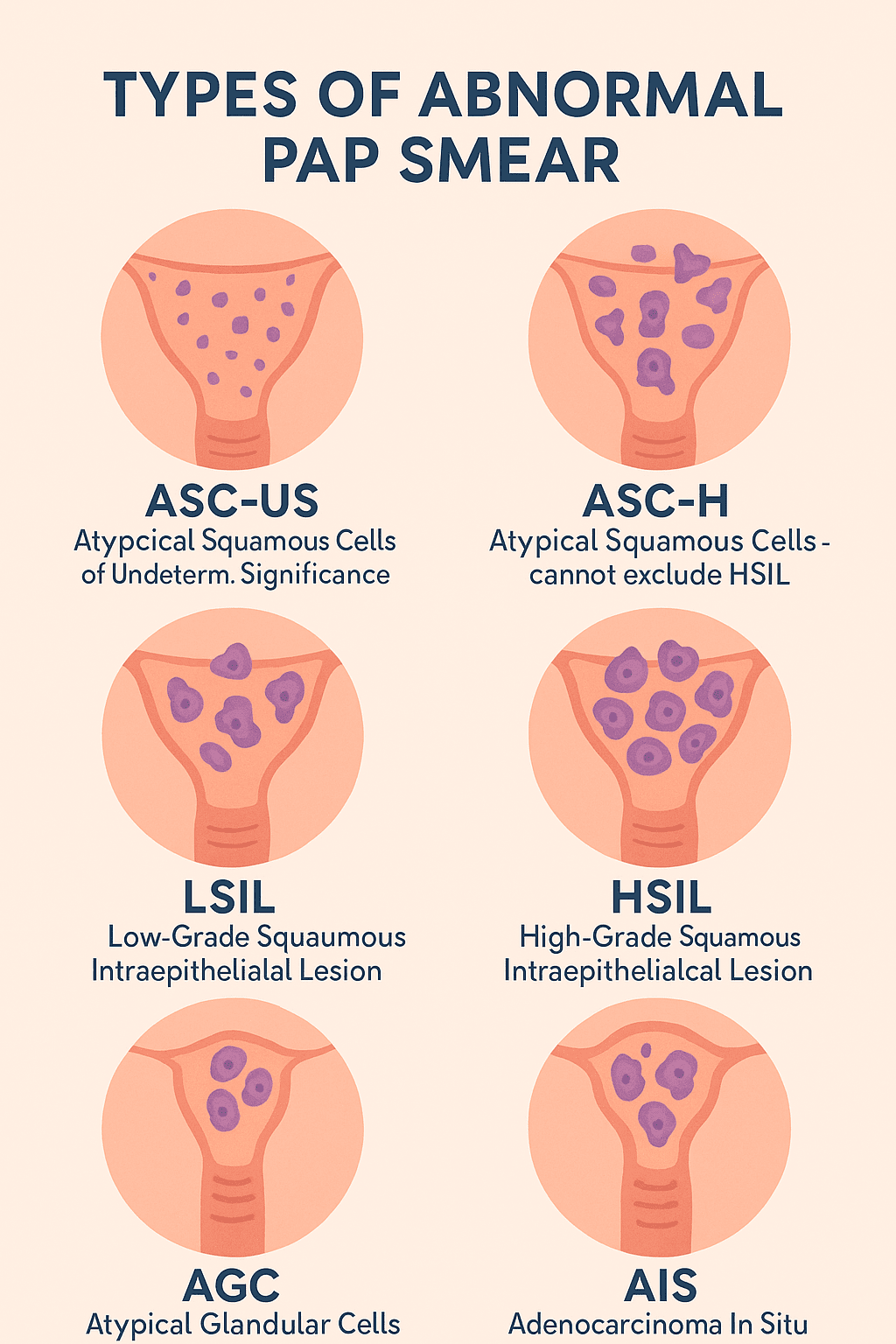
Types of Abnormal Pap Smear Results

an illustration of the types of abnormal pap smear

1. ASC-US (Atypical Squamous Cells of Undetermined Significance)

  • The most common abnormal result.

  • Cells don’t look completely normal, but it’s unclear if HPV or irritation caused the change.

  • Often requires HPV testing or repeat Pap in 12 months.

2. ASC-H (Atypical Squamous Cells – cannot rule out HSIL)

  • Cells look abnormal and may show early precancerous changes.

  • Needs colposcopy (a closer exam of the cervix).

3. LSIL (Low-Grade Squamous Intraepithelial Lesion)

  • Mild changes, often caused by HPV infection.

  • In many cases, these go away on their own, especially in younger women.

4. HSIL (High-Grade Squamous Intraepithelial Lesion)

  • More serious cell changes.

  • Indicates precancerous changes that need further testing and may require treatment.

5. AGC (Atypical Glandular Cells)

  • Glandular cells (from inside the cervix or uterus) look abnormal.

  • Can be associated with precancer or cancer — requires further testing.

6. AIS (Adenocarcinoma In Situ)

  • Precancerous cells found in the glandular tissue of the cervix.

  • Needs treatment because it can become cervical cancer.

7. Cervical Cancer Cells (Squamous Cell Carcinoma or Adenocarcinoma)

  • Rare finding.

  • Indicates cancer is present — requires urgent follow-up.


Quick Summary Table

Pap Smear Result Type What It Means Next Step
ASC-US Slightly abnormal cells, unclear cause HPV test or repeat Pap
ASC-H Abnormal cells that may be precancerous Colposcopy
LSIL Mild changes, usually HPV-related Often repeat Pap or colposcopy
HSIL More serious changes, possible precancer Colposcopy and possible treatment
AGC Abnormal glandular cells Further evaluation (colposcopy, biopsy)
AIS Precancer of glandular tissue Treatment recommended
Cancerous cells Rare Specialist evaluation immediately

When to See a Doctor

If you receive any abnormal result—even mild—follow-up is important. Early detection prevents cervical cancer.

Possible Causes of an Abnormal Pap Smear

When unusual or abnormal cells are found in your Pap smear, your Medex specialist refers to it as a positive result. There are several possible causes of an abnormal Pap smear. These include:

• Atypical squamous cells of undetermined significance. Slightly abnormal squamous cells, which are the cells that grow on the surface of the cervix, are often a sign of an infection. An infection may be caused yeast, bacteria or protozoa. They also may be the result of the papillomavirus (HPV), a virus that can cause cervical cancer.

• Atypical glandular cells. Your Pap smear may also reveal an abnormality in your glandular cells, which are cells that grow in the opening of your uterus.

• Squamous cell intraepithelial lesions. These are cells that may be precancerous. They’re considered low-grade or high-grade, depending on how much the cells have changed.

• Squamous cell cancer. When cancer cells have been detected, it means further tests and treatment are required. Women who obtain regular Pap smears are unlikely to get this result.

Your doctor may tell you that your Pap smear results were unclear or unsatisfactory. This means the lab was unable to get a clear reading, which is usually caused by not having enough cells in the sample. If results are unclear, you may be asked to come in for a repeat test.

The Next Step after an Abnormal Pap Smear

Further testing is recommended following an abnormal Pap smear. Your Queens doctor may recommend an HPV test to look for the presence of HPV cells that have been associated with cervical cancer. You may undergo a test called a colposcopy, which is similar to a Pap smear. It allows your doctor to examine the cervical cells more closely under a lighted magnifying tool. Your doctor may remove a small sample of tissue for a biopsy.

Most women who have an abnormal Pap smear don’t have cancer. Cervical cells go through a lot of changes before they become cancerous. A Pap smear is a way to identify these changes so that you get treatment early, when it’s most effective. Early detection and intervention also keep you from developing other serious complications.

Treatment for Cervical Cell Abnormalities

Treatment for any abnormality in the cells of your cervix depends on the severity of the diagnosis. Your doctor may recommend watching and waiting if changes are considered low to moderate. A follow-up Pap smear in six months may be recommended to ensure there haven’t been any further developments.

Moderate to severe cell changes may indicate a higher risk of developing cervical cancer. You may need treatment to destroy or remove abnormal cells. Your gynecologist may decide to perform a loop electrosurgical excision procedure (LEEP), which involves using a heated wire loop to remove abnormal tissue. Another method of removing abnormal issue is through conization, a minimally invasive surgical procedure in which tissue is removed in a cone-shaped piece.

Protecting Yourself from Cervical Cancer

The earlier cervical cancer is diagnosed, the easier it is to treat. Routine Pap smears are recommended annually for women between the ages of 21 and 65. Certain risk factors increase your risk of developing cervical cancer: such as:

  • Smoking cigarettes
  • A weakened immune system from HIV, an organ transplant or chemotherapy

Immunizations, vaccines and safe sexual practices also improve your odds of receiving normal Pap smear results. Follow a healthy lifestyle consisting of maintaining the proper weight for your body type, eating a nourishing, low-fat diet and exercising regularly. These habits build your immune system to protect your body from gynecological disorders.

You and your doctor decide what’s best for you based on your medical history and any risk factors you have, such as a family history of cervical cancer. Contact the Medex Diagnostic and Treatment Center for expert gynecological care in Queens.

Preguntas frecuentes – Prueba de Papanicolaou anormal en Queens, NY

  1. ¿Qué significa una citología vaginal anormal?
    Una citología vaginal anormal indica que algunas células del cuello uterino tienen un aspecto distinto del normal. No significa necesariamente que tengas cáncer, pero pueden ser necesarias más pruebas para descartar cambios precancerosos o cancerosos.
  2. ¿Qué causa un resultado anormal en la citología vaginal?
    Entre las causas más frecuentes están la infección por el virus del papiloma humano (VPH), la inflamación, la actividad sexual reciente, las infecciones vaginales o los cambios hormonales.
  3. ¿Es lo mismo una citología vaginal anormal que tener el VPH?
    No siempre. Aunque el VPH es la causa más frecuente de células cervicales anormales, otros factores como la infección o la inflamación también pueden desencadenar resultados anormales.
  4. ¿Qué debo hacer después de una citología vaginal anormal?
    Tu médico puede recomendarte una prueba de Papanicolaou de seguimiento, una prueba del VPH o una colposcopia, un procedimiento que permite observar más de cerca el cuello uterino para determinar la causa de la anomalía.
  5. ¿Qué es una colposcopia y es dolorosa?
    Una colposcopia es un sencillo procedimiento en consulta en el que un especialista utiliza un dispositivo de aumento para examinar el cuello uterino. Puede causar ligeras molestias, pero generalmente no es dolorosa.
  6. ¿Los resultados anormales de la citología vaginal pueden volver a la normalidad?
    Sí. En muchos casos, sobre todo en mujeres jóvenes, las células anómalas vuelven a la normalidad por sí solas sin tratamiento, sobre todo si están causadas por una infección leve por VPH.
  7. ¿Con qué frecuencia debo hacerme una citología vaginal en Queens, NY?
    Las mujeres de 21 a 65 años deben hacerse una citología vaginal cada 3 años, o cada 5 años si se combina con la prueba del VPH, en función de sus antecedentes de salud y factores de riesgo.
  8. ¿Puedo prevenir las citologías anormales?
    Aunque no todos los resultados anormales pueden prevenirse, vacunarse contra el VPH, practicar sexo seguro, evitar fumar y acudir a revisiones periódicas puede reducir tu riesgo.
  9. ¿Cuáles son los tipos de resultados anormales de la citología vaginal?
    Las categorías habituales son ASC-US (células escamosas atípicas de significado indeterminado), LSIL (lesiones de bajo grado), HSIL (lesiones de alto grado) y AGC (células glandulares atípicas).
  10. ¿Es necesario el tratamiento para todos los resultados anormales de la citología vaginal?
    No siempre. Las anomalías leves suelen resolverse por sí solas. Las alteraciones más graves pueden requerir procedimientos como el LEEP (procedimiento de escisión electroquirúrgica con asa) o la crioterapia.
  11. ¿Por qué elegir Medex Diagnostic and Treatment Center para el seguimiento de la citología vaginal anormal en Queens, NY?
    Medex ofrece atención gineco-obstétrica compasiva con herramientas de diagnóstico avanzadas y citas el mismo día. Nuestros experimentados profesionales te guiarán en cada paso -desde las pruebas hasta el tratamiento- con claridad y apoyo.
  12. ¿Cómo programo una citología o una cita de seguimiento en Medex en Queens?
    Puedes reservar una cita llamando a nuestra oficina o visitando medexdtc.com. Ofrecemos consultas sin cita previa, citas para el mismo día y atención en varios idiomas para atender a la diversa comunidad de Queens.

Stay In Touch Contact Us