
111-29 Queens Blvd, Forest Hills, NY 11375
111-29 Queens Blvd, Forest Hills, NY 11375


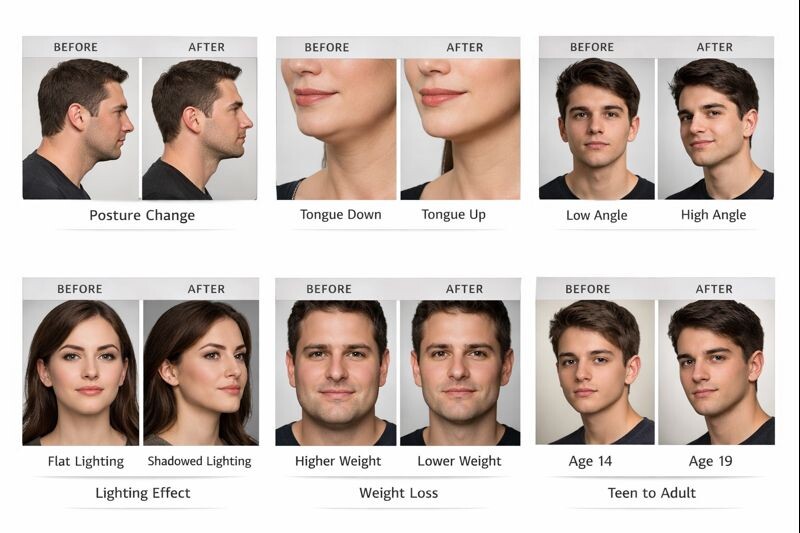
People search “mewing before and after” because the photos can look dramatic: sharper jawline, better profile, “forward” chin, less double-chin. The honest truth is that most “after” results are explained by posture, body-fat changes, and photography tricks, not permanent jaw reshaping. Major orthodontics say there’s no solid scientific evidence that mewing can reliably change adult facial bone structure.
Important note about the images below: They are examples of the type of “before/after” photos commonly shared online, not medically verified transformations. Online comparisons can be misleading without controlled conditions.
Mewing is a viral name for oral posture training: resting your tongue on the roof of your mouth (palate), lips closed, and breathing through your nose. It’s associated with “orthotropics,” popularized by John Mew and Mike Mew.
A simple way to think about it:
Learn more: what is mewing >
Here are the most common reasons the “after” looks wildly better:
If you:
Why it happens: the soft tissue under the jaw stretches differently and shadows change.
Tongue up can reduce the appearance of “softness” under the jaw in the moment.
Why it happens: the tongue and floor-of-mouth muscles influence the contour seen under the chin.
A close selfie with a wide-angle lens can distort the face:
Hard side lighting creates a crisp jaw shadow. Flat lighting hides it.
Many “after” photos coincide with fat loss, gym, or just aging into a leaner face.
In teens, the face is still developing. Changes over a year may be normal growth, orthodontics, or lifestyle, not necessarily tongue posture.
Use this to avoid fooling yourself (or your audience):
If the improvement only appears in the “best posture” set, that’s not a permanent structural change—it’s posture/positioning.
If you interpret “mewing” as healthy resting posture + nasal breathing (when medically appropriate), it’s usually reasonable. But if you’re doing forceful pushing hoping to remodel your jaw, be cautious.
Orthodontic experts warn that unsupervised attempts to change bite/jaw can backfire or delay proper care.
If you have:
…talk to an orthodontist or ENT instead of relying on internet techniques.
How long does mewing take to see results?
Most “fast results” are instant posture/angle effects. Permanent structural claims aren’t supported by strong evidence.
Can mewing fix a recessed chin?
Photos may look better with posture. True skeletal issues typically require professional evaluation.
Does mewing work better for teenagers?
Faces change naturally during growth. Separating growth/orthodontics from “mewing” is hard, which is why online before/afters can be misleading.
“Mewing before and after” transformations are mostly:
not guaranteed jaw remodeling. If your goal is health, focus on good posture, nasal breathing (if possible), and professional care for bite/airway issues.
Continue reading: How Hormones Impact Your Ability to Lose Weight, Vibration Plate Benefits, Epithelial Cell Abnormality.
Medex Diagnostic and Treatment Center
Coronavirus Disease (Covid19 IgG/IgM) FDA-approved rapid antibody tests, COVID-19, and Flu vaccine are now available at MEDEX medical office.