
111-29 Queens Blvd, Forest Hills, NY 11375
111-29 Queens Blvd, Forest Hills, NY 11375


Demon Face Syndrome is a rare visual perception disorder in which a person temporarily sees distorted or demonic-looking faces when looking at other people. The condition is medically linked to prosopometamorphopsia, a neurological disorder that alters facial perception. While the person knows the faces are not truly distorted, their brain visually processes them as twisted, stretched, or frightening.
A neurologist is usually the primary doctor for this condition. They evaluate brain function and investigate neurological causes such as stroke, migraines, or epilepsy.
The syndrome itself is not typically dangerous, but it may signal an underlying neurological issue that requires medical evaluation.
For example, facial distortion may occur with conditions such as:
Because of this, medical assessment is important, especially if symptoms appear suddenly.
If you experience sudden vision changes, distorted faces, or other neurological symptoms, seeking medical care promptly can help protect your health and ensure proper diagnosis. At Medex Diagnostic and Treatment Center, our team works with specialists to help identify the source of unusual vision symptoms and guide patients toward the appropriate treatment.
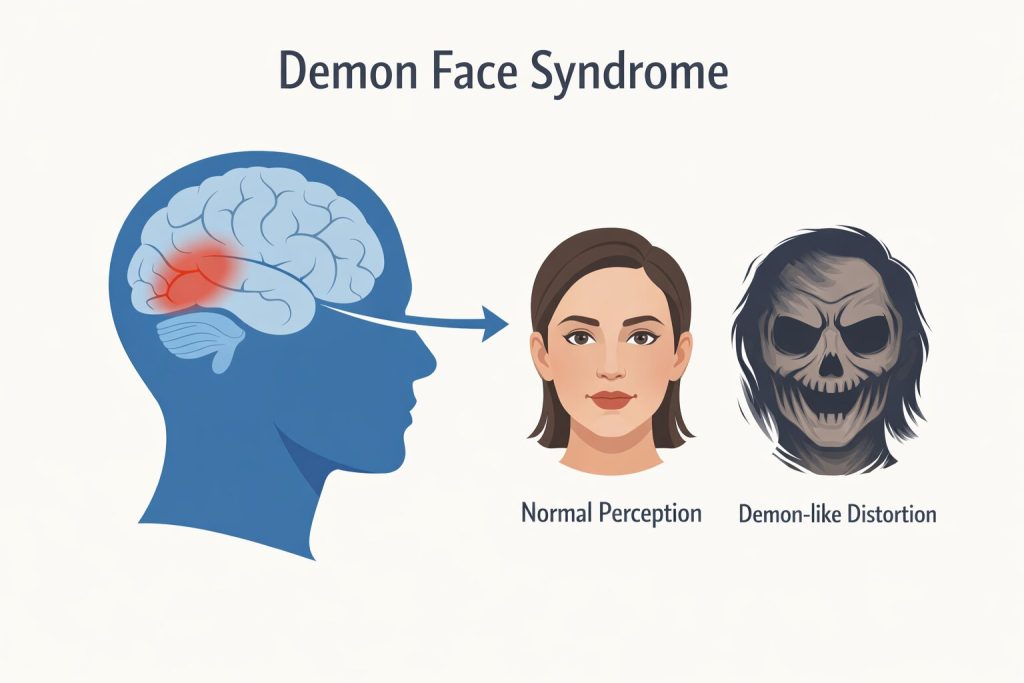
“Demon Face Syndrome” is a term that gained attention after medical case reports described patients who consistently perceived faces as grotesque or demon-like. The scientific name for this condition is prosopometamorphopsia, a rare disorder affecting how the brain processes faces.
People with this condition usually see normal surroundings, but when they look at a person’s face, it appears:
Importantly, individuals experiencing this disorder typically understand that the distortion is not real, meaning it is different from hallucinations or psychiatric disorders.
The condition is believed to occur due to changes in specific brain regions responsible for facial recognition, particularly in the temporal lobe and occipital lobe.
Although it sounds alarming, Demon Face Syndrome is extremely rare and often linked to underlying neurological or visual conditions.
The main symptom of Demon Face Syndrome is visual distortion of human faces. However, several additional symptoms may occur depending on the underlying cause.
1. Facial Distortion
People’s faces may appear:
Some patients describe the faces as “demonic,” “grotesque,” or “monstrous.”
2. Normal Vision Otherwise
A key characteristic is that everything else looks normal, including:
Only human faces appear distorted.
3. Distortion Appears in Real Life but Not in Photos
Some individuals report that faces appear normal in photographs or on screens, but distorted in real life. This helps doctors identify that the issue is related to brain processing rather than eyesight alone.
4. Awareness That the Image Is Not Real
Most patients maintain full awareness that the distorted faces are a visual illusion caused by their brain
This is an important diagnostic clue that separates the condition from psychosis or hallucinations.
5. Anxiety or Distress
Seeing distorted faces repeatedly can cause:
The emotional impact can be significant, especially if the symptoms last for weeks or months.
Demon Face Syndrome is not a disease itself but rather a symptom of a neurological condition affecting facial perception.
1. Brain Injury or Trauma
Damage to brain areas responsible for facial processing can lead to distorted facial perception.
Possible causes include:
2. Stroke
A stroke affecting the temporal or occipital lobes may disrupt facial recognition pathways.
3. Migraine Disorders
Some severe migraines can cause temporary visual distortions, including altered facial perception.
4. Epilepsy
Seizure activity in specific brain regions can interfere with visual processing.
5. Brain Lesions or Tumors
In rare cases, abnormalities in the brain can affect the fusiform face area, which is responsible for recognizing faces.
6. Visual Processing Disorders
Certain conditions affecting visual pathways may cause distortions specifically related to faces.
The syndrome itself is not typically dangerous, but it may signal an underlying neurological issue that requires medical evaluation.
For example, facial distortion may occur with conditions such as:
Because of this, medical assessment is important, especially if symptoms appear suddenly.
You should seek medical attention if you experience:
Sudden visual changes could be a sign of a neurological emergency such as a stroke, and prompt evaluation is essential.
If you experience symptoms of Demon Face Syndrome, the following specialists can help diagnose the cause:
A neurologist is usually the primary doctor for this condition. They evaluate brain function and investigate neurological causes such as stroke, migraines, or epilepsy.
A neuro-ophthalmologist specializes in vision problems related to the nervous system and can assess how the brain processes visual information.
An eye doctor may evaluate whether the symptoms are related to retinal or optic nerve conditions.
Your primary doctor can help coordinate testing and refer you to specialists if needed.
At Medex Diagnostic and Treatment Center, patients can receive comprehensive evaluations and referrals to the appropriate specialists when neurological or vision symptoms occur.
Doctors typically diagnose the condition through a combination of tests.
Neurological examination
Doctors assess reflexes, coordination, and cognitive function.
Brain imaging
Tests may include:
These help identify structural changes in the brain.
Vision testing
Eye exams evaluate whether the distortion originates from the eyes or the brain.
Patient symptom descriptions
Detailed descriptions of what the patient sees help physicians identify prosopometamorphopsia.
Treatment depends on the underlying cause rather than the visual distortion itself.
Treating neurological conditions
If the cause is related to migraines, epilepsy, or stroke, treating the underlying condition may resolve the visual symptoms.
Medication
Doctors may prescribe medications for:
Vision therapy
Some patients benefit from visual rehabilitation therapy.
Monitoring
In some cases, symptoms may gradually improve without specific treatment.
Since the syndrome is usually caused by neurological issues, prevention focuses on maintaining brain and vascular health.
Protect your brain
Manage migraine triggers
Common triggers include:
Control cardiovascular health
Reducing stroke risk helps prevent neurological damage.
Key strategies include:
Seek medical care early
Prompt evaluation of unusual visual symptoms may prevent complications.
Although frightening at first, many people find reassurance in learning that the condition is a neurological visual distortion rather than a psychiatric problem.
Support from healthcare providers, neurological evaluation, and treatment of underlying causes often help patients regain normal visual perception.
No. Demon Face Syndrome is not a psychiatric disorder. It is typically caused by neurological changes in how the brain processes faces.
It is extremely rare and has only been documented in a small number of medical case reports.
No. People with the condition usually recognize that the distorted faces are not real, which distinguishes it from hallucinations.
Yes. In some cases, symptoms improve once the underlying neurological condition is treated.
Visual distortions such as Demon Face Syndrome should always be evaluated by medical professionals to rule out neurological causes. At Medex Diagnostic and Treatment Center, our team works with specialists to help identify the source of unusual vision symptoms and guide patients toward the appropriate treatment.
If you experience sudden vision changes, distorted faces, or other neurological symptoms, seeking medical care promptly can help protect your health and ensure proper diagnosis.
Medex is a multi-specialty clinic with 24-hour urgent care, primary care, and more than 30 board-certified specialists, including podiatry, cardiology, dermatology, pain management, gynecology, and physical therapy. Each department works under one roof for seamless referrals.
Yes. Every Medex doctor is board-certified in their specialty, undergoes peer review, and participates in ongoing CME (continuing medical education). Credentials are listed on our Meet the Doctors page.
Absolutely. Our Queens urgent care clinic is open for walk-in patients with minor injuries or sudden illnesses. You can also save time by reserving a same-day slot online.
Medex accepts all major commercial carriers plus Medicare, Medicaid, HIP, EmblemHealth, MetroPlus, Fidelis, and GHI. For specific coverage questions, call (718) 275-8900 or visit our Insurance page.
Use our secure online booking portal, call (718) 275-8900, or log in to the Patient Portal to reschedule.
Yes—most primary care and follow-up visits can be conducted via HIPAA-compliant video. Sign the Telemedicine Consent Form and choose “Virtual” when booking.
Yes. Our No-Fault Doctor Queens team handles car- accident injuries, and our Workers’ Comp Clinic manages job-related injuries and paperwork.
We’re at 111-29 Queens Blvd, Forest Hills, NY 11375—steps from the Forest Hills–71 Av subway station (E, F, M, R lines). A paid garage is next door and metered street parking surrounds the building.
We follow HIPAA privacy rules, store EHR data on encrypted servers, and require two-factor authentication for staff access. You may request records through our ChartRequest portal.
Adults in good health should schedule an annual physical. Patients managing chronic conditions may need follow-ups every 3–6 months; your doctor will advise a personalized schedule.
For safety, we require an active chart and a visit within the past 12 months (3 months for controlled substances). Ask your pharmacy to send an electronic refill request or message us through the Patient Portal.
Last reviewed: March 22, 2026.
Medex Diagnostic and Treatment Center
Coronavirus Disease (Covid19 IgG/IgM) FDA-approved rapid antibody tests, COVID-19, and Flu vaccine are now available at MEDEX medical office.