
111-29 Queens Blvd, Forest Hills, NY 11375
111-29 Queens Blvd, Forest Hills, NY 11375


Chronic Venous Insufficiency (CVI) is a condition in which damaged or weakened vein valves in the legs cause blood to pool instead of flowing back to the heart, leading to swelling, leg pain, varicose veins, skin discoloration, and venous ulcers.
Common CVI treatments available in Queens, NY include:
Most procedures are minimally invasive, performed in-office, and require little to no downtime.
Dr. Mohammed Islam, M.D., a board-certified Vascular Surgeon at Medex Diagnostic and Medical Center (111-29 Queens Blvd, Forest Hills, NY 11375), specializes in CVI diagnosis and treatment. Fellowship-trained at the Arizona Heart Institute and Baylor College of Medicine, Dr. Islam is accepting new patients.
📞 Call (718) 275-8900 or book online at medexdtc.com.
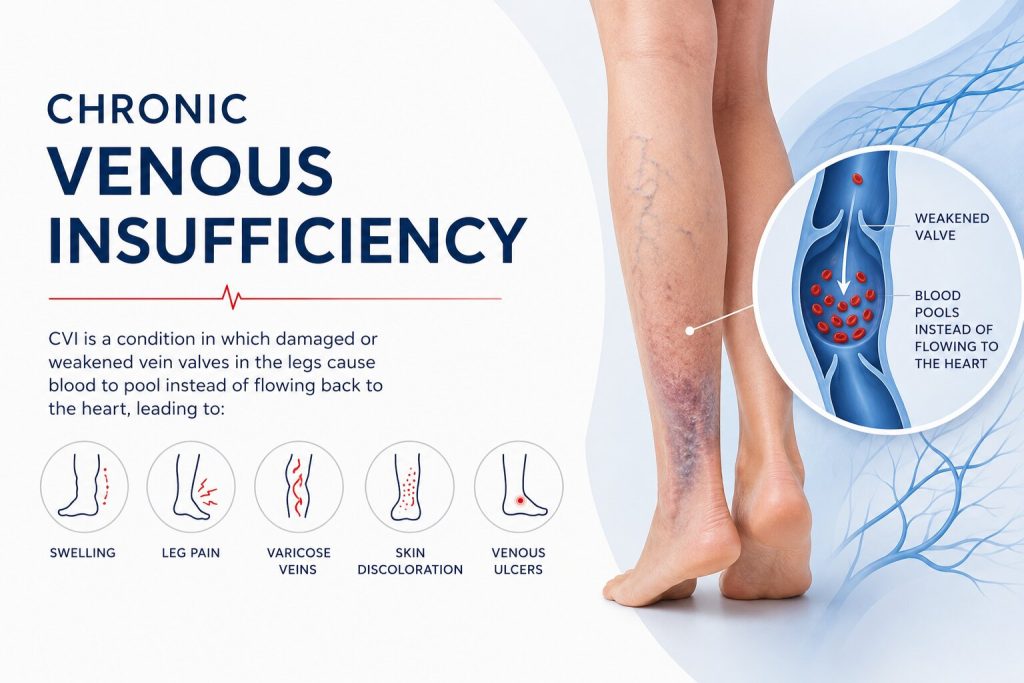
Chronic Venous Insufficiency, commonly referred to as CVI, is a progressive vascular condition in which the veins of the legs lose their ability to efficiently pump blood back up to the heart. Normally, tiny one-way valves inside the veins open to allow blood to flow upward and then close to prevent it from flowing backward. When these valves become weakened or damaged, blood pools in the lower legs — a process called venous reflux — leading to increased pressure, swelling, pain, and a range of other uncomfortable and sometimes debilitating symptoms.
CVI is far more common than many people realize. It affects millions of Americans and is one of the leading causes of leg discomfort, swollen ankles, and chronic leg wounds. Left untreated, CVI can worsen over time and lead to serious complications, including venous ulcers that are difficult to heal. The good news is that effective treatments are available — and if you are searching for chronic venous insufficiency treatment near Queens, NY, expert help is right around the corner.
CVI develops when the venous valves fail to function properly. Several factors can contribute to this valve dysfunction, including:
Deep Vein Thrombosis (DVT): A blood clot in the deep veins can damage valves and obstruct blood flow, leading to post-thrombotic syndrome and eventually CVI.
Varicose Veins: Enlarged, twisted surface veins are often both a symptom and a contributing cause of CVI. When the superficial venous system is under prolonged pressure, valves weaken and fail.
Prolonged Standing or Sitting: Professions that require long periods of standing (nurses, teachers, retail workers) or sitting (office workers, drivers) put continuous strain on leg veins.
Pregnancy: The increased blood volume and pressure on pelvic veins during pregnancy can stretch and weaken vein walls and valves.
Age and Gender: CVI becomes more common with age, and women are more frequently affected than men, partly due to hormonal influences on vein wall elasticity.
Obesity: Excess body weight increases abdominal and pelvic pressure, making it harder for blood to return from the legs to the heart.
Family History: A genetic predisposition to weak vein walls or valve dysfunction can increase your risk of developing CVI.
Recognizing the symptoms of CVI early is key to preventing the condition from advancing. The symptoms often start subtly and worsen gradually. Common signs and symptoms include:
Leg Swelling (Edema): Swelling in the lower legs, ankles, and feet — particularly toward the end of the day or after prolonged standing — is one of the most frequent complaints.
Leg Heaviness and Fatigue: Many patients describe their legs feeling tired, heavy, or achy, especially after being on their feet for extended periods.
Varicose Veins: Bulging, rope-like veins visible under the skin are a hallmark feature of CVI in many patients.
Skin Changes: Over time, increased venous pressure can cause the skin around the lower legs and ankles to darken, harden, or develop a leathery texture (a condition called lipodermatosclerosis).
Itching and Burning: Chronic inflammation in the skin caused by blood pooling can produce persistent itching, redness, or a burning sensation.
Leg Cramping: Nighttime leg cramps or restless legs are common complaints among those with venous insufficiency.
Venous Stasis Ulcers: In advanced cases, the skin breaks down and open sores develop, typically near the ankle. These wounds are slow to heal and prone to infection.
Aching or Throbbing: A dull, persistent ache or throbbing pain in the leg that worsens with standing and improves with elevation is a telling sign of CVI.
If you are experiencing any of these symptoms, do not delay seeking evaluation. Early diagnosis and treatment from a qualified vein specialist in Queens, NY can prevent CVI from progressing to more serious stages.
Physicians use the CEAP classification system (Clinical, Etiology, Anatomy, Pathophysiology) to categorize venous disease by severity. Understanding the stages helps clarify what treatment options are most appropriate:
C0 – No visible or palpable signs of venous disease: Symptoms such as leg heaviness or aching may be present even without visible changes.
C1 – Telangiectasias or Reticular Veins: Small spider veins or fine reticular veins appear on the skin surface. These are largely a cosmetic concern at this stage but may indicate underlying venous pressure.
C2 – Varicose Veins: Larger, bulging varicose veins become visible. This is when most patients seek evaluation, as discomfort becomes more noticeable.
C3 – Edema: Swelling of the ankle and lower leg appears regularly, indicating that elevated venous pressure is affecting the surrounding tissue.
C4 – Skin Changes: The skin around the lower leg develops discoloration (hyperpigmentation), thickening, eczema, or lipodermatosclerosis — all signs of chronic venous pressure damage.
C5 – Healed Venous Ulcer: The skin has experienced a previous ulcer that has since closed, but the underlying venous problem remains and carries a high risk of recurrence.
C6 – Active Venous Ulcer: An open, non-healing wound is present. This is the most advanced stage of CVI and requires immediate medical attention.
Seeing a vascular specialist early — before reaching C4, C5, or C6 — dramatically improves outcomes and quality of life.
Diagnosing CVI begins with a thorough medical history and physical examination. Your doctor will assess your legs for signs of swelling, skin changes, varicosities, and tenderness. The cornerstone diagnostic tool is the Venous Duplex Ultrasound, a painless, non-invasive imaging test that uses sound waves to visualize blood flow through the veins and identify valve dysfunction, reflux, or obstruction. Additional tests such as a venous Doppler study may also be used to evaluate blood flow patterns in the deep and superficial venous systems.
Treatment for CVI is highly individualized and depends on the severity of the condition, the anatomy of the affected veins, the patient’s overall health, and their goals. Today, there are many effective, minimally invasive options that allow patients to return to normal activities quickly.
For mild-to-moderate CVI, conservative measures are often recommended as a first step:
Compression Therapy: Graduated compression stockings apply external pressure to the legs, helping the veins push blood upward more efficiently. They are often the first line of management for swelling and discomfort.
Leg Elevation: Raising the legs above the level of the heart for 30 minutes several times per day helps reduce venous pressure and edema.
Exercise and Lifestyle Modifications: Walking, leg exercises, and weight management help improve calf muscle pump function, which is essential for venous return.
When conservative therapy is insufficient or when CVI is more advanced, a vein specialist may recommend one or more minimally invasive procedures:
Endovenous Laser Ablation (EVLA/EVLT): A thin laser fiber is inserted into the diseased vein. Laser energy heats the vein from the inside, causing it to collapse and seal shut. Blood is naturally redirected to healthy veins. This procedure is performed in-office under local anesthesia with minimal downtime.
Endovenous Radiofrequency Ablation (RFA): Similar to laser ablation, radiofrequency energy is used to heat and close the diseased vein. RFA is known for being gentle and precise, with very low rates of post-procedure bruising or discomfort.
Sclerotherapy: A specialized chemical solution (sclerosant) is injected directly into varicose or spider veins, causing them to shrink, scar, and eventually fade. Sclerotherapy is highly effective for smaller veins and reticular veins.
VenaSeal: A medical-grade adhesive is injected into the diseased vein to seal it closed. VenaSeal requires no tumescent anesthesia and does not rely on heat, making it an excellent option for patients with sensitive skin or needle sensitivity.
Varithena (Polidocanol Injectable Foam): A specially formulated foam sclerosant that displaces blood in the vein and causes it to collapse. It is effective for treating both the main truncal veins and their branches.
Ambulatory Phlebectomy: Small incisions are used to physically remove superficial varicose veins through a micro-hook technique. This is often combined with ablation procedures for comprehensive results.
Iliocaval Intervention and Intravascular Ultrasound (IVUS): For patients with deep venous obstruction — often caused by May-Thurner syndrome or post-thrombotic changes — interventional procedures to open blocked iliac or vena cava segments may be indicated.
For patients with active venous ulcers (C6), wound care is an essential component of treatment. This involves specialized dressings, compression bandaging, infection management, and treating the underlying venous disease to promote healing and prevent recurrence.
If you are looking for a leading expert in chronic venous insufficiency treatment near Queens, Forest Hills, or the greater New York City area, Mohammed Islam, M.D. at Medex Diagnostic and Medical Center is one of the most experienced and highly regarded vascular surgeons and vein specialists in the region.
Dr. Islam is a Vascular Fellowship-trained General and Endovascular Surgeon with decades of experience diagnosing and treating the full spectrum of venous and arterial conditions. He completed his Vascular/Endovascular Surgery Fellowship at the Arizona Heart Institute in Phoenix, Arizona, and a second Vascular Surgery Fellowship at the prestigious Baylor College of Medicine in Houston, Texas. He holds board certification from the American Board of Surgery, is a Fellow of the American College of Surgeons, and is a Certified Member of the International Endovascular Society.
Throughout his distinguished career, Dr. Islam has served as a mentor and trainer for young surgeons in advanced endovascular techniques. He established the Office-Based Lab (OBL) program at Metro Vascular and brings unparalleled expertise in:
Dr. Islam treats the complete range of venous and vascular conditions, including Chronic Venous Insufficiency (CVI), varicose veins, spider veins, Deep Vein Thrombosis (DVT), Peripheral Arterial Disease (PAD), carotid artery disease, aortic aneurysms, lymphedema, and dialysis access complications.
He is currently accepting new patients and provides second opinions for patients who have already received a CVI diagnosis or prior vascular workup.
Medex Diagnostic and Medical Center is a trusted, Article 28-licensed multi-specialty medical center serving the Queens and greater New York City community for over 25 years. Located at 111-29 Queens Blvd, Forest Hills, NY 11375 — just steps from the Forest Hills–71 Av subway station (E, F, M, R lines) — Medex offers patients the convenience of comprehensive vascular care under one roof, alongside more than 30 other medical specialties.
At Medex, patients with CVI benefit from:
Is Chronic Venous Insufficiency curable? While CVI cannot always be completely cured in the traditional sense, it is highly treatable. Minimally invasive procedures combined with lifestyle modifications can eliminate symptoms, prevent progression, and significantly improve quality of life.
How long does CVI treatment take? Most in-office procedures such as laser ablation and sclerotherapy take less than an hour. Patients typically resume light activity the same day and return to full activity within a few days.
Will my insurance cover CVI treatment? Most insurance plans, including Medicare and Medicaid, cover medically necessary CVI treatments. Cosmetic-only procedures may not be covered. The team at Medex can verify your coverage prior to treatment.
What happens if CVI is left untreated? Untreated CVI progressively worsens. Patients risk developing severe skin changes, chronic leg wounds (venous ulcers), recurrent infections, and significantly reduced mobility and quality of life.
How do I know if I need to see a vein doctor? If you experience persistent leg swelling, varicose veins, leg heaviness, skin discoloration, or wounds near the ankle that are slow to heal, you should schedule an evaluation with a qualified vascular specialist.
Don’t let Chronic Venous Insufficiency control your life. Relief is available, and expert care is close to home. Dr. Mohammed Islam, M.D. and the team at Medex Diagnostic and Medical Center are ready to evaluate your symptoms, perform diagnostic imaging, and create a personalized CVI treatment plan tailored to your needs.
Medex Diagnostic and Medical Center 111-29 Queens Blvd, Forest Hills, NY 11375 Phone: (718) 275-8900 Hours: Monday–Friday, 9:00 AM – 8:00 PM
Schedule your appointment online at www.medexdtc.com or call (718) 275-8900 today. Serving patients in Forest Hills, Jackson Heights, Rego Park, Kew Gardens, Jamaica, Flushing, Astoria, Long Island City, and all surrounding Queens neighborhoods.
Medex Diagnostic and Treatment Center
Coronavirus Disease (Covid19 IgG/IgM) FDA-approved rapid antibody tests, COVID-19, and Flu vaccine are now available at MEDEX medical office.