
111-29 Queens Blvd, Forest Hills, NY 11375
111-29 Queens Blvd, Forest Hills, NY 11375


Leg pain when standing is aching, heaviness, cramping, burning, or discomfort in one or both legs that occurs or worsens while standing, often due to muscle fatigue, nerve or joint problems, or circulation issues such as venous insufficiency. Leg pain when standing can be caused by muscle fatigue, joint or nerve problems, or circulation issues such as chronic venous insufficiency (CVI) and varicose veins. If leg pain happens regularly or is accompanied by swelling or varicose veins, consider seeing a vein specialist for a vascular evaluation.
At Medex Diagnostic and Treatment Center patients with persistent leg pain can be evaluated for vascular and other potential causes of their symptoms.
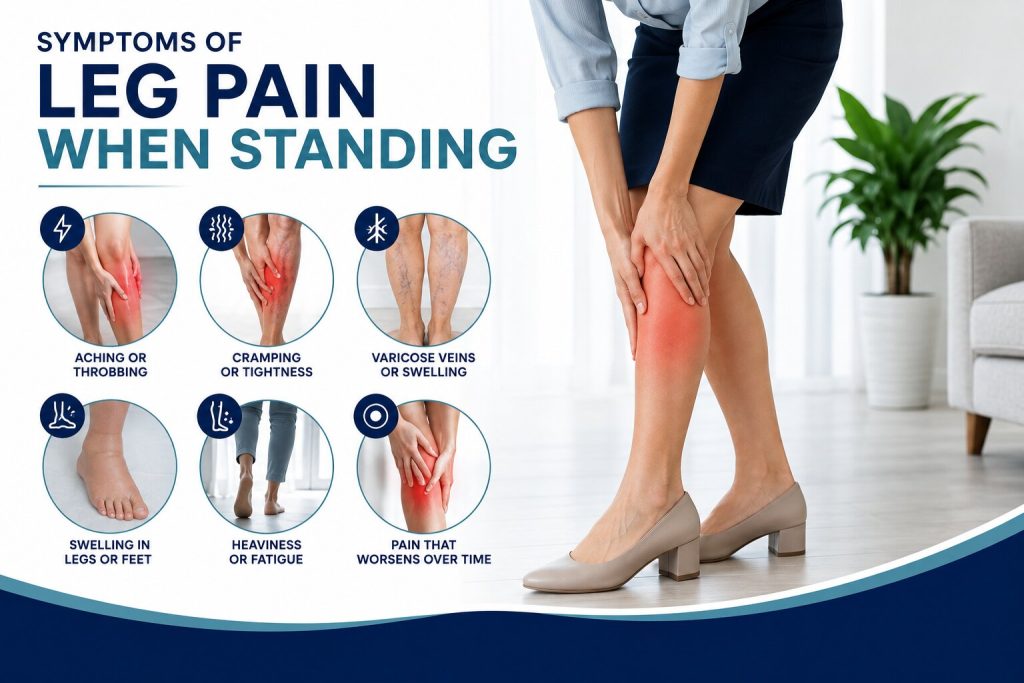
When the valves inside your leg veins aren’t working efficiently, blood can have difficulty traveling upward toward your heart. Instead, some blood can pool in the lower legs. Because gravity increases pressure in the veins while you’re upright, symptoms may become more noticeable the longer you stand.
This can lead to leg pain that gets worse after standing, ankle or lower-leg swelling, heaviness, fatigue, cramping, visible veins, and skin changes.
Vein-related leg pain often feels like aching, heaviness, throbbing, cramping, or burning that gets worse after prolonged standing and may improve when you elevate your legs. Swelling around the ankles, visible veins, or skin discoloration can also suggest a vein problem. Leg pain when standing for long periods is common, but persistent aching, heaviness, throbbing, burning, or swelling in your legs shouldn’t automatically be dismissed as tired muscles.
One possible cause is a problem with the circulation in your legs, particularly chronic venous insufficiency (CVI) or varicose veins.
However, vein disease isn’t the only possible cause of leg pain while standing. Muscle and joint problems, nerve compression, spinal conditions, peripheral artery disease (PAD), and other medical conditions can produce similar symptoms.
If your legs regularly hurt after standing, especially when the pain is accompanied by swelling or visible veins, a medical evaluation can help identify the cause.
If your legs hurt after you’ve been standing for a while, possible causes include:
One important clue is how your symptoms change throughout the day and with changes in position.
Venous insufficiency commonly causes dull aching, heaviness, or cramping that gets worse while standing and may improve when the legs are elevated.
If this pattern sounds familiar, your leg pain may warrant a vein evaluation.
Your veins have an especially difficult job.
Arteries carry blood away from your heart, while the veins in your legs must return blood upward toward your heart, often working against gravity.
Small one-way valves inside healthy veins help prevent blood from flowing backward. Your calf muscles also help squeeze the veins as you walk, creating a natural “muscle pump” that assists circulation.
When you remain standing in one place for an extended period, that muscle-pump action is reduced.
If your vein valves are also weakened or damaged, blood can begin accumulating in the lower extremities. This increases pressure within the veins and may contribute to pain, swelling, heaviness, and other symptoms.
That is why some people feel relatively comfortable in the morning but notice increasingly uncomfortable legs toward the end of the workday.
Chronic venous insufficiency (CVI) occurs when veins have difficulty efficiently returning blood from the legs toward the heart.
One of the characteristic patterns is discomfort that becomes worse after spending extended periods standing.
Possible symptoms include:
You don’t necessarily need to have large, bulging varicose veins to have underlying venous disease.
For some patients, leg aching, heaviness, or swelling is what first prompts an evaluation.
Pay attention to what happens when you sit or lie down and elevate your feet.
Pain associated with venous insufficiency may improve with leg elevation because raising the legs can reduce the effect of gravity and make it easier for blood to return toward the heart.
A pattern such as:
Feels better in the morning → worsens after standing → legs feel heavy or swollen in the evening → improves after elevation
It isn’t enough to diagnose venous insufficiency by itself, but it is useful information to share with your doctor.
Long periods of standing can affect almost anyone, but certain occupations make prolonged standing unavoidable.
People working in:
may spend many hours each day on their feet.
Standing itself doesn’t mean that you have vein disease. But prolonged standing can make symptoms of an existing vein problem much more noticeable.
For someone with weakened vein valves, several hours of standing may lead to increasing venous pressure and symptoms such as aching, heaviness, throbbing, and ankle swelling.
If this happens repeatedly rather than only after an unusually strenuous day, it is worth discussing with a healthcare professional.
Patients describe venous discomfort in different ways.
Instead of sharp pain, it may feel like:
Aching: A persistent dull ache, especially in the calves or lower legs.
Heaviness: Your legs may feel unusually heavy or difficult to move by the end of the day.
Throbbing: Some people notice pulsating or throbbing around visible veins.
Burning: Irritated or enlarged veins may be associated with burning sensations.
Tightness: Swelling can make the lower legs or ankles feel tight.
Cramping: Leg cramps, including nighttime cramps, can occur in people with chronic venous disease.
Fatigue: Your legs may simply feel exhausted despite relatively little physical activity.
The combination of aching + heaviness + swelling after prolonged standing is particularly worth discussing with a vein specialist.
Tell your doctor exactly when the pain occurs because different patterns can point toward different causes.
This pattern may occur with venous insufficiency, particularly when it is accompanied by swelling, heaviness, visible veins, or improvement with leg elevation.
This can occur with peripheral artery disease (PAD).
PAD involves reduced arterial blood flow to the extremities. A classic symptom is muscle pain or cramping that develops during physical activity and improves with rest.
This pattern can occur with lumbar spinal stenosis, where narrowing around the spinal nerves can produce pain, weakness, numbness, or cramping in the legs.
A nerve problem such as sciatica may be responsible.
Because these conditions require different treatments, identifying the source of persistent leg pain is more important than simply treating the pain itself.
Yes. Varicose veins develop when superficial veins become enlarged and twisted, often because the valves responsible for controlling blood flow aren’t functioning effectively.
For some people they’re primarily cosmetic.
For others, varicose veins can be associated with:
Symptoms may become particularly noticeable after spending hours standing.
Visible varicose veins combined with recurring leg discomfort are a good reason to consider a vascular evaluation.
Mild temporary swelling can have many causes.
However, recurring swelling of the ankles and lower legs, particularly when it becomes worse toward the end of the day, is also commonly seen with chronic venous insufficiency.
Over time, more advanced venous disease can cause additional changes around the lower legs and ankles, including:
Early evaluation can help determine whether swelling is related to the veins or another medical condition.
Yes. Visible varicose veins are only one possible manifestation of venous disease.
A person may experience symptoms such as:
without having dramatic veins visible on the surface.
That is one reason a medical evaluation and, when appropriate, vascular ultrasound can be more informative than simply looking at the legs.
Evaluation generally starts with a medical history and physical examination.
Your doctor may ask:
If venous disease is suspected, a duplex ultrasound may be recommended.
A venous duplex ultrasound is a noninvasive imaging test that allows a healthcare professional to evaluate the veins and blood flow in your legs.
It can help identify problems such as abnormal backward blood flow, known as venous reflux, and can also be used when evaluating for obstruction or blood clots.
The information helps your vascular specialist determine whether your symptoms are related to venous disease and which veins may be affected.
Consider scheduling an evaluation if you repeatedly experience:
Symptoms don’t have to become severe before you speak with a doctor.
Identifying venous disease earlier may allow your physician to recommend conservative or minimally invasive treatment before more advanced complications develop.
Not all leg pain should wait for a routine vein appointment.
A deep vein thrombosis (DVT) is a blood clot that commonly develops in a deep vein of the leg.
Possible DVT symptoms include:
DVT requires prompt medical attention.
A clot can sometimes travel to the lungs and cause a pulmonary embolism (PE), which can be life-threatening.
Seek emergency medical attention for symptoms such as sudden difficulty breathing, chest pain, coughing up blood, fainting, or a rapid or irregular heartbeat.
Do not attempt to diagnose a possible blood clot yourself.
Treatment depends on the underlying problem and its severity.
For mild venous disease, a doctor may recommend conservative measures such as:
If significant venous reflux or symptomatic varicose veins are identified, additional treatment may be considered.
Modern vein treatment is frequently minimally invasive and can often be performed without traditional major surgery.
Depending on your diagnosis and individual circumstances, treatment options may include:
Graduated compression stockings can help reduce swelling and support venous blood flow in appropriately selected patients.
A medication is injected into selected abnormal veins, causing them to close so blood can naturally reroute through healthier veins.
Laser energy is delivered through a thin catheter to close an unhealthy vein affected by venous reflux.
RFA uses controlled radiofrequency energy to close an abnormal vein.
A specialized medical adhesive is used to close an affected vein in appropriately selected patients.
A microfoam treatment can be used for certain symptomatic varicose veins.
Small surface varicose veins can be removed through tiny skin openings.
Not every person with leg pain needs a vein procedure. The first step is determining why your legs hurt.
Living and working in New York can mean spending a considerable part of the day on your feet.
Healthcare workers, restaurant employees, teachers, retail professionals, construction workers, commuters, and many other New Yorkers may spend hours standing or walking.
Feeling tired after an unusually long day isn’t necessarily a sign of vascular disease.
But if you regularly think:
“My legs hurt every time I stand for a long time,”
especially if you also experience swelling, heaviness, varicose veins, or symptoms that improve after elevating your legs, it may be time to investigate your circulation.
Mohammed Islam, M.D., is a vascular and endovascular surgeon at Medex Diagnostic and Treatment Center who evaluates and treats conditions including chronic venous insufficiency, varicose veins, and other vascular disorders.
Patients looking for a vein specialist in Queens or New York City can receive diagnostic evaluation and an individualized treatment plan based on the cause and severity of their symptoms.
If standing leaves your legs aching, swollen, heavy, or throbbing day after day, don’t assume that discomfort is simply something you have to live with.
The symptoms may have a treatable underlying cause.
Medex Diagnostic and Treatment Center
111-29 Queens Blvd
Forest Hills, NY 11375
Phone: (718) 275-8900
Schedule a vascular evaluation to determine whether chronic venous insufficiency, varicose veins, or another vascular condition may be contributing to your leg pain.
Prolonged standing can contribute to muscle fatigue, but recurring aching may also be associated with venous insufficiency. When vein valves don’t function efficiently, blood can accumulate in the lower legs while you’re upright, contributing to pressure, aching, heaviness, and swelling.
Several conditions can improve when you sit, so this symptom alone doesn’t establish a diagnosis. Venous symptoms may improve when you rest or elevate your legs, while spinal stenosis can also produce leg symptoms that improve with sitting or leaning forward. A medical evaluation can distinguish between possible causes.
Long periods on your feet can cause muscle fatigue and can make underlying vein problems more noticeable. If pain occurs regularly and is accompanied by swelling, heaviness, varicose veins, or improvement with elevation, consider a vascular evaluation.
Yes, but “poor circulation” can refer to different problems. Venous insufficiency affects blood returning from the legs toward the heart, while peripheral artery disease affects arterial blood reaching the legs. Their symptom patterns and treatments differ.
People commonly describe aching, heaviness, tiredness, burning, cramping, or throbbing. Swelling can also occur, especially after prolonged standing or later in the day.
Symptoms that become worse after prolonged standing, improve with leg elevation, and occur alongside ankle swelling, heaviness, varicose veins, or skin changes can suggest a venous cause. A vascular examination and duplex ultrasound can help determine whether venous reflux is present.
Yes. Chronic venous disease can produce symptoms even when large varicose veins aren’t visible. Aching, swelling, heaviness, cramping, or skin changes can sometimes be the more noticeable symptoms.
Persistent leg pain accompanied by swelling, heaviness, visible varicose veins, skin changes, or symptoms that worsen with prolonged standing may warrant a vascular evaluation.
Often it isn’t an emergency, but the cause matters. Sudden one-sided swelling, warmth, redness, or unexplained tenderness can be signs of DVT and require prompt medical evaluation. Chest pain or difficulty breathing associated with a possible blood clot requires emergency medical attention.
A venous duplex ultrasound is commonly used to evaluate vein structure and blood flow. It can help detect venous reflux, obstruction, and other vascular abnormalities.
If testing confirms that symptomatic varicose veins or venous reflux are contributing to your pain, treating the underlying vein problem may reduce symptoms. Treatment should be based on an individual vascular evaluation rather than symptoms alone.
Medical Disclaimer: This article is intended for general educational and informational purposes only and does not constitute medical advice, diagnosis, or treatment. Leg pain can have many causes, including conditions requiring urgent medical attention. Always consult a qualified healthcare professional regarding symptoms, diagnosis, and appropriate treatment. If you believe you are experiencing a medical emergency, seek emergency medical care immediately.
Medex Diagnostic and Treatment Center
Coronavirus Disease (Covid19 IgG/IgM) FDA-approved rapid antibody tests, COVID-19, and Flu vaccine are now available at MEDEX medical office.