
111-29 Queens Blvd, Forest Hills, NY 11375
111-29 Queens Blvd, Forest Hills, NY 11375


Shingles is a viral infection that causes a painful, blistering skin rash. Shingles can appear anywhere on the body, and mild early shingles often begins subtly, burning, tingling, itching, or “sunburn-like” sensitivity in a small area, before the rash becomes obvious. When the rash develops, it most often shows up as a single band or stripe of fluid-filled blisters on one side of the torso (left or right), though it can also occur on the neck, face, scalp, or around an eye. Learn early signs, rash stages, treatment timing, and when to see a doctor.
Shingles is caused by the varicella-zoster virus, the same virus that causes chickenpox. After you recover from chickenpox, the virus doesn’t leave your body; it stays dormant in nerve tissue for life. Years (or decades) later, the virus can reactivate and travel along a nerve pathway to the skin, triggering the characteristic pain and rash known as shingles.
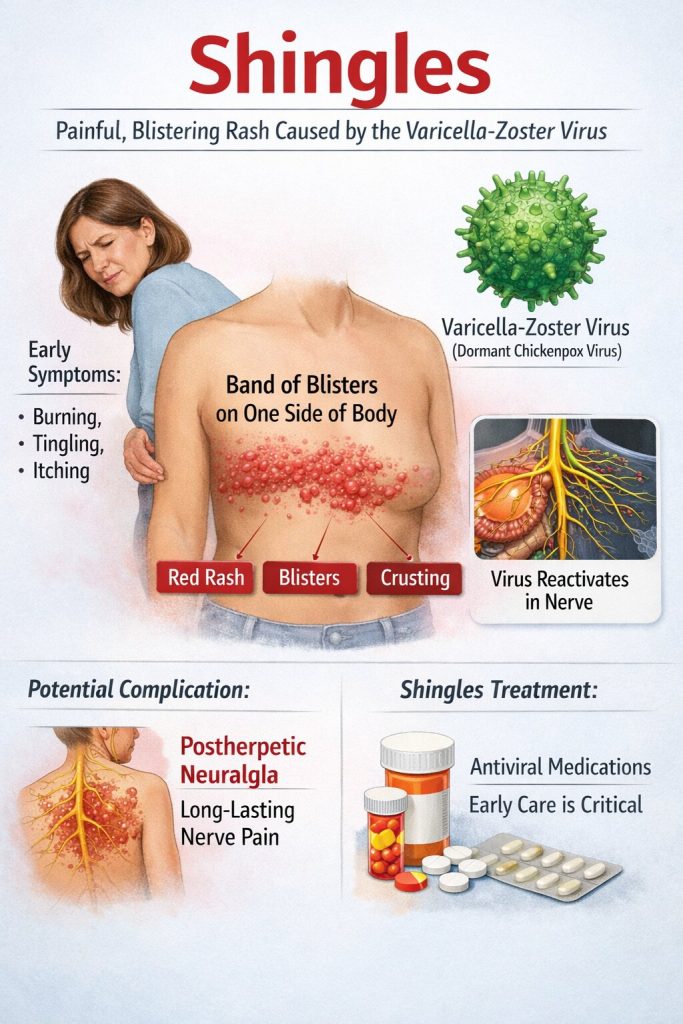
Shingles isn’t usually life-threatening, but it can be intensely painful and may interfere with sleep, work, and daily activities. Vaccination can significantly lower your risk. If shingles is suspected, early treatment, ideally started as soon as symptoms begin and within the first few days of the rash, can shorten the infection, reduce severity, and lower the risk of complications. The most common complication is postherpetic neuralgia, a condition in which damaged nerves continue sending pain signals long after the blisters have crusted and healed.
If you’re noticing mild burning, tingling, or sensitivity on one side of your body, especially on your torso or face, you might be in the early (prodromal) stage of shingles. Shingles (also called herpes zoster) is a viral nerve infection that can start subtly before any rash appears. The earlier you get evaluated, the better your chances of shortening the illness and lowering the risk of long-lasting nerve pain.
At Medex Diagnostic & Treatment Center in Queens, NY, our medical team can evaluate suspected shingles quickly and guide treatment, including urgent care decisions when the rash is near the eye.
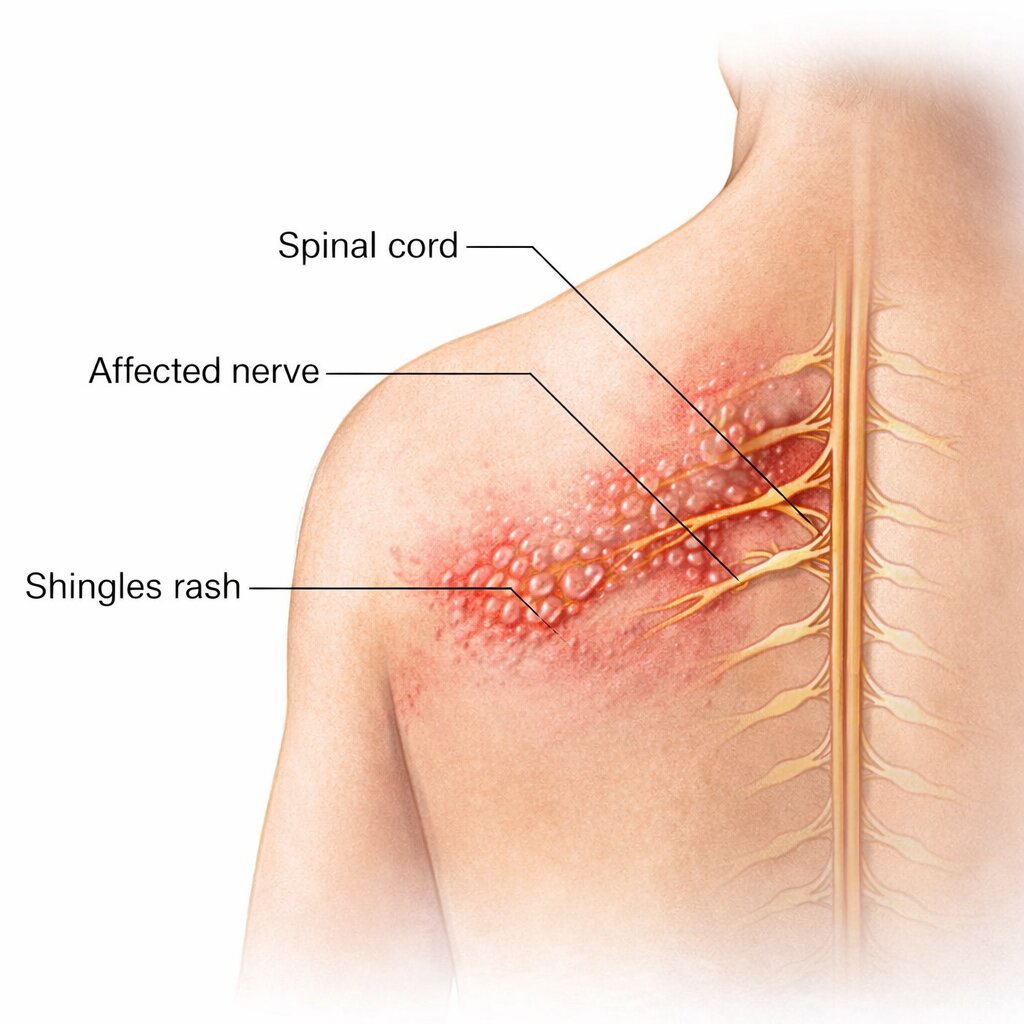
Mild early shingles is the beginning stage of shingles when symptoms may feel minor and look like almost nothing, but the virus is already inflaming a nerve. You may have:
Many people think they pulled a muscle, slept wrong, or have an allergy, until the rash forms.
Shingles is a painful rash caused by the varicella-zoster virus, the same virus that causes chickenpox. After chickenpox, the virus stays inactive in the body and can reactivate years later as shingles. Shingles usually appears as a stripe or cluster on one side of the body (commonly the torso), but it can also occur on the face, neck, scalp, or around one eye.
Shingles isn’t typically life-threatening, but it can be extremely painful and may cause complications—especially without early treatment.
Early shingles often starts before the rash, and symptoms usually stay in a small area on one side of the body.
Key clue: shingles typically follows a nerve path (dermatome), so it forms a band/stripe pattern and usually stays on one side.
In the earliest visible stage, shingles may look like:
Within a short time, it often evolves into:
If you suspect shingles, it’s better to come in early, even if the rash seems minor.
Antiviral medications work best when started as early as possible, ideally within 72 hours of rash onset (and sometimes even when strongly suspected before the rash fully develops). Early treatment can:
Contact a provider right away if:
If you have eye redness, eye pain, light sensitivity, or a rash on the forehead/nose: treat this as urgent.
Shingles can spread the varicella-zoster virus to someone who has never had chickenpox or the chickenpox vaccine, but it causes chickenpox, not shingles.
You’re contagious until:
Avoid close contact with:
Shingles happens when the chickenpox virus reactivates in a nerve. Risk increases with:
Some people recover fully without problems. Others may develop complications such as:
A clinician can often diagnose shingles based on:
If needed, testing may include:
Treatment depends on your timing, symptoms, and risk factors. Common approaches include:
Often prescribed to reduce severity/duration:
Shingrix is recommended in the U.S. for:
It’s given as:
Vaccination can significantly reduce your risk of shingles and complications—even if you’ve had shingles before (your clinician can advise timing).
At Medex Diagnostic & Treatment Center (Queens, NY), shingles evaluation typically starts with:
If you call for an appointment, tell the team you suspect “mild early shingles” and note when symptoms started and whether the rash is near your eye.
Can shingles start with just itching and no rash?
Yes. Early shingles can start with itching, tingling, burning, or skin sensitivity before any rash appears.
How long does mild early shingles last before the rash shows up?
It varies. Some people develop a rash within 1–3 days of early nerve symptoms, but timing differs.
Can shingles be mild and still dangerous?
It can be “mild” at first but still lead to complications—especially if it involves the eye or if you’re immunocompromised.
Should I go to the doctor if I’m not sure it’s shingles?
Yes, especially if symptoms are one-sided and painful/sensitive. Early treatment matters.
Does shingles always happen on the torso?
No. The torso is common, but shingles can appear on the face, neck, scalp, or around an eye.
Medex Diagnostic and Treatment Center
Coronavirus Disease (Covid19 IgG/IgM) FDA-approved rapid antibody tests, COVID-19, and Flu vaccine are now available at MEDEX medical office.