
111-29 Queens Blvd, Forest Hills, NY 11375
111-29 Queens Blvd, Forest Hills, NY 11375


Peripheral Arterial Disease (PAD) is a circulatory condition in which narrowed arteries reduce blood flow to the legs and feet due to plaque buildup (atherosclerosis). It affects over 8 million Americans and significantly raises the risk of heart attack, stroke, and limb loss if left untreated.
Receive expert PAD diagnosis and treatment at Medex Diagnostic and Treatment Center in Forest Hills. Call (718) 275-8900 to schedule your consultation.
📍 111-29 Queens Blvd, Forest Hills, NY 11375 📞 (718) 275-8900 🌐 Book an appointment online
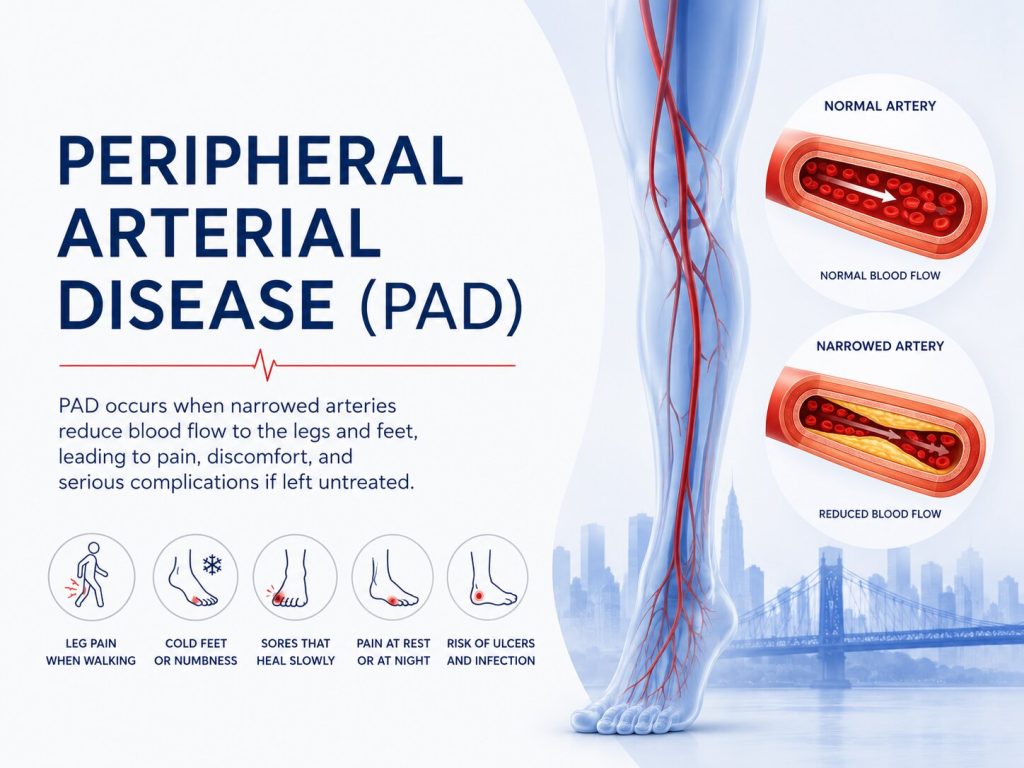
Peripheral Arterial Disease, commonly known as PAD, is a serious circulatory condition in which narrowed arteries reduce blood flow to the limbs, most often the legs and feet. It occurs when fatty deposits, known as plaque, build up inside the arterial walls, a process called atherosclerosis. As arteries become increasingly narrowed or blocked, the muscles and tissues in the lower extremities are deprived of the oxygen-rich blood they need to function properly.
PAD is more common than many people realize. According to the American Heart Association, it affects more than 8 million Americans, many of whom go undiagnosed for years. Left untreated, PAD significantly increases the risk of heart attack, stroke, and in severe cases, limb amputation.
If you or a loved one is experiencing leg pain, cramping, or numbness, especially while walking, you may be experiencing symptoms of PAD. Residents of Queens, Forest Hills, Jackson Heights, Rego Park, Flushing, and surrounding areas in New York can now access expert PAD diagnosis and treatment right in their own neighborhood at Medex Diagnostic and Treatment Center.
PAD does not develop overnight. Certain risk factors significantly increase your likelihood of developing this condition. You should consider speaking with a vascular specialist if you:
People of South Asian, African American, or Hispanic descent are also statistically at higher risk for PAD, making it especially important for the diverse communities throughout Queens, NY to be aware of this condition and its warning signs.
One of the most challenging aspects of PAD is that many patients experience no obvious symptoms in the early stages, or they attribute their discomfort to normal aging. This makes routine screening critically important, particularly for individuals with the risk factors listed above.
When symptoms do appear, they typically affect the legs, feet, and sometimes the hips or buttocks. The most common warning signs of PAD include:
Intermittent claudication is the hallmark symptom of PAD. It refers to pain, cramping, aching, or fatigue in the muscles of the legs, particularly the calves, thighs, or hips, that occurs during physical activity such as walking and is relieved by rest. This happens because the narrowed arteries cannot deliver enough blood to meet the muscles’ increased demand during exercise.
Leg pain at rest is a more advanced symptom. When PAD has progressed significantly, patients may experience burning or aching pain in the foot or toes even while sitting or lying down. This is known as rest pain and indicates critical limb ischemia.
Numbness or weakness in the legs or feet may be a sign that blood flow has been chronically reduced to nerve and muscle tissue.
Cold or discolored skin on the feet or lower legs, including skin that appears pale, bluish, or has a dusky reddish color when the leg is lowered, can indicate poor circulation.
Slow-healing wounds or sores on the feet or toes that take weeks or months to close are a serious warning sign. Poor blood flow impairs the body’s ability to heal, which can lead to dangerous infections.
Shiny, thinning, or hairless skin on the legs and feet is another physical indicator of reduced blood supply to the area.
Thickened toenails that grow abnormally may also be a sign of poor circulation.
Erectile dysfunction in men can sometimes be an early indicator of PAD, as the same vascular narrowing affecting leg arteries may affect pelvic circulation as well.
If you are experiencing any of these symptoms and live in or near the Queens, NY area, do not wait. Early diagnosis is the key to preventing serious complications.
PAD is generally classified by its severity and the arteries it affects. Understanding the type and stage of PAD helps your vascular specialist develop the most appropriate treatment plan.
Many patients have PAD without any noticeable symptoms. This is detected through diagnostic testing such as the ankle-brachial index (ABI) test or a vascular ultrasound. Even without symptoms, the underlying arterial narrowing poses a significant cardiovascular risk.
This is the most commonly recognized stage of PAD. Patients experience reproducible muscle pain or cramping during exercise that resolves within minutes of rest. The location of the pain often indicates which arteries are affected, calf pain typically points to femoral or popliteal artery disease, while hip or buttock pain may suggest aortoiliac disease.
This is the most severe form of PAD. Patients with CLI experience chronic rest pain, non-healing ulcers, and tissue death (gangrene). CLI requires urgent medical intervention to restore blood flow and prevent amputation.
This is a sudden, dramatic reduction or complete blockage of blood flow to a limb, often caused by a blood clot (thrombus or embolus). It presents as a sudden onset of pain, pallor, pulselessness, paresthesia (numbness/tingling), and paralysis, and is a vascular emergency requiring immediate treatment.
This type involves the aorta and iliac arteries in the pelvis and upper thighs. It commonly causes hip, buttock, and thigh pain during walking, and in men, may be accompanied by erectile dysfunction (known as Leriche Syndrome).
This is the most common type of PAD, affecting the femoral and popliteal arteries of the thigh and knee region. It typically presents as calf pain and cramping with exertion.
This type affects the arteries below the knee (tibial and peroneal arteries) and is especially common in patients with diabetes. It is a leading cause of foot ulcers and lower limb amputations if not treated promptly.
Diagnosing PAD begins with a thorough medical history and physical examination. Your vascular surgeon will assess pulses in your legs and feet, look for skin changes, and ask about your symptoms. Diagnostic tests commonly used include:
Ankle-Brachial Index (ABI): This non-invasive test compares blood pressure in your ankle to blood pressure in your arm. A low ABI ratio is a strong indicator of PAD.
Doppler Ultrasound: Sound waves are used to visualize blood flow through the arteries and detect blockages or narrowing. Medex offers arterial Doppler ultrasound testing on-site.
CT Angiography (CTA) or MR Angiography (MRA): These imaging studies create detailed pictures of the arteries to pinpoint the location and severity of blockages.
Conventional Angiography: In some cases, a contrast dye is injected into the arteries and X-rays are taken to provide a precise road map of arterial disease, often performed in conjunction with a treatment procedure.
Treatment for PAD depends on the severity of the disease. The goals of treatment are to relieve symptoms, slow the progression of arterial disease, and reduce the risk of serious complications such as heart attack, stroke, and limb loss.
For patients with mild to moderate PAD, meaningful improvements can be achieved through lifestyle changes, including smoking cessation (one of the most important interventions for slowing PAD progression), a heart-healthy diet, regular supervised exercise, and weight management.
Several classes of medications are used to manage PAD and reduce cardiovascular risk. These include antiplatelet agents such as aspirin or clopidogrel to reduce blood clotting, statins to lower cholesterol and stabilize plaque, antihypertensive medications to control blood pressure, medications to control blood sugar in diabetic patients, and cilostazol, a medication specifically approved for improving walking distance in patients with claudication.
Structured, medically supervised walking programs have been shown to significantly improve walking distance and quality of life in PAD patients. Your doctor will design a program tailored to your fitness level and symptoms.
When lifestyle changes and medications are not enough, minimally invasive procedures can be used to restore blood flow. These include:
Angioplasty (Percutaneous Transluminal Angioplasty or PTA): A catheter with a small balloon at its tip is guided to the blocked artery. The balloon is inflated to open the narrowed section and restore blood flow.
Stenting: A small metal mesh tube (stent) is placed inside the artery after angioplasty to keep it open and prevent re-narrowing.
Atherectomy: A catheter-based device is used to physically remove plaque buildup from the artery walls.
Thrombolysis: In cases of acute arterial blockage due to a clot, clot-dissolving medications (thrombolytics) can be delivered directly to the site of the blockage through a catheter.
In severe cases of PAD where arteries are extensively blocked and endovascular approaches are not feasible, surgical bypass grafting may be performed. In this procedure, a healthy blood vessel (graft) is used to reroute blood around the blocked segment of artery, restoring circulation to the affected limb.
If you are looking for a highly experienced vascular surgeon in Queens, NY who specializes in Peripheral Arterial Disease, look no further than Mohammed Islam, M.D. at Medex Diagnostic and Treatment Center in Forest Hills.
Dr. Islam is a Vascular Fellowship-trained General and Vascular Surgeon with decades of experience in the diagnosis and minimally invasive treatment of arterial and venous conditions. His credentials include:
Dr. Islam has served as a mentor to numerous young surgeons, helping to train the next generation of endovascular specialists. He has extensive expertise in performing advanced vascular procedures including angioplasty, stenting, atherectomy, Intravascular Ultrasound (IVUS), Iliocaval intervention, and treatment for a broad range of vascular conditions including Peripheral Arterial Disease (PAD), Deep Vein Thrombosis (DVT), Carotid Artery Disease, Aortic Aneurysms, and more.
Patients throughout Queens, including Forest Hills, Rego Park, Jackson Heights, Flushing, Astoria, Jamaica, and Howard Beach, come to Dr. Islam for expert, compassionate vascular care that combines cutting-edge technology with personalized attention.
Dr. Islam is currently accepting new patients and welcomes individuals seeking a second opinion on a PAD diagnosis or vascular condition.
Medex Diagnostic and Treatment Center is a state-licensed, Article 28 multi-specialty medical center located at 111-29 Queens Blvd, Forest Hills, NY 11375, conveniently accessible from the E, F, M, and R subway lines at the Forest Hills–71 Av station.
At Medex, patients benefit from:
Peripheral Arterial Disease is a progressive condition that can have life-altering consequences if left untreated. But with the right specialist and the right treatment plan, you can relieve your symptoms, protect your limbs, and dramatically reduce your risk of heart attack and stroke.
Do not ignore leg pain, cramping, numbness, or slow-healing wounds. These could be your body’s warning signs that your arteries need attention.
Contact Medex Diagnostic and Treatment Center today to schedule your Peripheral Arterial Disease evaluation with Dr. Mohammed Islam, M.D.
📍 111-29 Queens Blvd, Forest Hills, NY 11375 📞 (718) 275-8900 🌐 Book an appointment online
Serving patients from Queens, Forest Hills, Rego Park, Jackson Heights, Flushing, Astoria, Jamaica, Howard Beach, and all surrounding neighborhoods in New York City.
This article is intended for informational purposes only and does not constitute medical advice. Please consult a qualified healthcare professional for diagnosis and treatment of any medical condition.
Medex Diagnostic and Treatment Center
Coronavirus Disease (Covid19 IgG/IgM) FDA-approved rapid antibody tests, COVID-19, and Flu vaccine are now available at MEDEX medical office.