
111-29 Queens Blvd, Forest Hills, NY 11375
111-29 Queens Blvd, Forest Hills, NY 11375


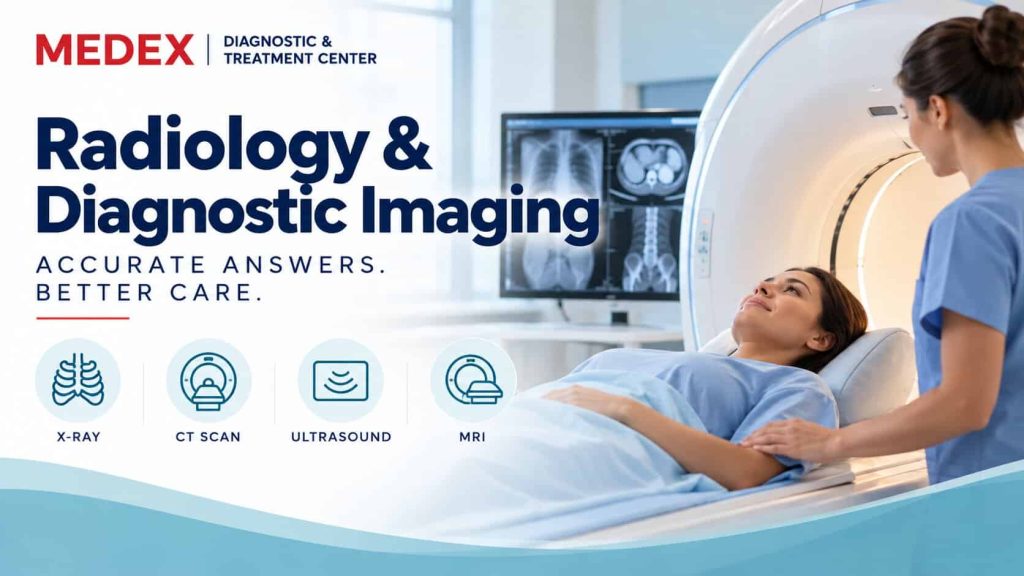
Medex Diagnostic and Treatment Center offers outpatient radiology and diagnostic imaging at 111-29 Queens Blvd in Forest Hills, Queens. Our imaging suite performs ultrasound, carotid and vascular Doppler studies, echocardiograms, DEXA bone density scans, and angiograms and venograms. Your doctors, imaging and specialists are all in the same building. That means you can often see a physician, get your scan and review the results without traveling between offices. We accept Medicare, Medicaid, most major insurance plans, No-Fault and Workers’ Compensation, and we’re open Monday to Friday until 8:00 pm.
Call (718) 275-8900 or book your imaging appointment online.
If you’re searching for radiology in Queens, Medex Diagnostic & Treatment Center offers convenient access to imaging services with a focus on comfort, speed, and clinical accuracy.
Ultrasound uses sound waves, not radiation, to create real-time images of organs, blood vessels and soft tissue. It’s safe for all ages, including during pregnancy, and can be repeated as often as needed. Most ultrasound exams take 20 to 45 minutes. We offer:
Learn more about sonograms at Medex in Queens.
A Doppler ultrasound shows how blood flows through your arteries and veins. It helps find blockages, narrowing, blood clots and vein problems, with no needles and no radiation.
An echocardiogram is an ultrasound of the heart. It shows how well your heart pumps and how your valves work. A stress echocardiogram compares images taken at rest and after exercise to check for reduced blood flow to the heart.
A DEXA bone density test uses a very low dose of X-ray to measure bone strength and diagnose osteopenia and osteoporosis. The scan takes about 10 to 20 minutes while you lie still on a padded table. It’s recommended for women 65 and older, and for younger adults with risk factors such as early menopause, long-term steroid use or a previous fracture.
For patients who need a closer look at blocked or narrowed blood vessels, our vascular team performs lower-extremity angiograms and outpatient venograms using contrast dye and fluoroscopy. When a blockage is found, it can often be treated in the same session.
We also offer nerve conduction testing for numbness, tingling and nerve injuries. It isn’t imaging, but it is often ordered alongside it.
Each test below has its own page with details on why it’s ordered, how it’s performed and how to prepare.
Ultrasound uses high-frequency sound waves, not radiation, to create real-time images of organs and soft tissue. It is the first-line imaging test for many abdominal, pelvic, thyroid and urinary complaints, and it is safe to repeat as often as your doctor needs to track a finding.
General overview of ultrasound exams at Medex and when they’re used.
Liver, gallbladder, pancreas, kidneys and spleen; often ordered for abdominal pain.
Screens for aortic aneurysm and narrowing of the body’s largest artery.
Uterus, ovaries and bladder; used for pelvic pain, bleeding and cysts.
Higher-detail view of the uterus and ovaries, including early pregnancy evaluation.
Evaluates nodules, goiter and thyroid enlargement.
Measures bladder volume and emptying; checks for stones or wall changes.
Testicular pain, swelling, lumps and varicocele evaluation.
Doppler ultrasound adds a measurement of blood flow to the standard image, showing where blood moves freely and where it is slowed or blocked. It is the go-to test for leg swelling, suspected clots, varicose veins, poor circulation and stroke-risk screening.
Checks the neck arteries for plaque and narrowing linked to stroke risk.
Evaluates leg and arm arteries for peripheral artery disease.
Detects deep vein thrombosis (DVT) and venous insufficiency.
Echocardiography is an ultrasound of the heart. It shows chamber size, wall motion, valve function and pumping strength without radiation.
Resting heart ultrasound for murmurs, shortness of breath and heart failure.
Heart imaging before and after exercise to uncover coronary artery disease.
A bone density scan uses a very low-dose X-ray technique to measure bone mineral content. It is the standard test for diagnosing osteoporosis and estimating fracture risk.
Osteoporosis screening and monitoring for women over 65, men over 70 and anyone with risk factors.
When ultrasound can’t fully answer the question, a contrast study uses X-ray guidance (fluoroscopy) and injected dye to map arteries or veins in detail. At Medex these are outpatient procedures, and a blockage found during the study can often be treated in the same session.
Lower-extremity arterial imaging with angioplasty or stenting when needed.
Detailed vein mapping when Doppler results are inconclusive.
Measures nerve signal speed for numbness, tingling and weakness.
Our board-certified specialists order and act on imaging every day:
| Specialty | Physician | Imaging they commonly use |
|---|---|---|
| Cardiology | Gagandeep Singh, MD, FACP, FACC Aditya Mangla, DO, FSCAI | Echocardiogram, stress echo, carotid Doppler |
| Vascular Surgery | Mohammed Islam, MD | Arterial & venous Doppler, angiogram, venogram |
| Gynecology | Chaim Kaplan, MD Ziyad A. Mansur, MD | Pelvic & transvaginal ultrasound |
| Urology | Ron Bakal, MD Dilip Doctor, MD | Bladder & scrotal ultrasound |
| Endocrinology | Hortencia Garcia, MD Andrew H. Maran, MD | Thyroid ultrasound, bone density |
| Gastroenterology | Boris Chusid, MD | Abdominal ultrasound |
| Primary Care & Internal Medicine | David Khasidy, MD Irina Benyaminova, DO | Abdominal ultrasound, bone density, first-line workups |
See every provider on our Medex DTC doctors page.
| Symptom or concern | Test often ordered first |
|---|---|
| Upper abdominal pain, bloating after fatty meals | Abdominal ultrasound |
| Pelvic pain, irregular or heavy bleeding | Pelvic or transvaginal ultrasound |
| Lump in the neck, abnormal thyroid labs | Thyroid ultrasound |
| Leg swelling, calf pain, suspected clot | Venous Doppler |
| Leg pain when walking, cold feet, slow-healing wounds | Arterial Doppler |
| Dizziness, TIA symptoms, carotid bruit | Carotid Doppler |
| Chest pain with exertion, shortness of breath, heart murmur | Echocardiogram or stress echo |
| Menopause, long-term steroid use, prior fragility fracture | Bone density test |
| Urinary retention, frequent urination | Bladder ultrasound |
| Testicular pain or swelling | Scrotal ultrasound |
This table is general information, not a diagnosis. Sudden severe chest pain, stroke symptoms or major trauma need 911 or the nearest emergency room.
| Exam | Typical preparation | Approx. time |
|---|---|---|
| Abdominal / aorta ultrasound | Nothing to eat or drink (except water and medications) for 6–8 hours before | 30–45 min |
| Pelvic ultrasound | Arrive with a full bladder: drink about 32 oz of water an hour before and don’t empty your bladder | 30 min |
| Transvaginal ultrasound | Empty your bladder right before the exam | 15–30 min |
| Thyroid, scrotal, bladder ultrasound | No special preparation | 15–30 min |
| Carotid, arterial, venous Doppler | Loose clothing; avoid lotion on the area being scanned | 30–60 min |
| Echocardiogram | No special preparation | 45–60 min |
| Stress echocardiogram | Comfortable shoes; follow your cardiologist’s instructions on caffeine and medications | 60–90 min |
| Bone density (DEXA) | Skip calcium supplements for 24 hours; wear clothing without metal | 15–20 min |
| Angiogram / venogram | Specific fasting, medication and ride-home instructions provided at scheduling | 1–3 hours incl. recovery |
Always follow the instructions given by our scheduling team or your doctor. They may differ from the typical guidance above.
If a Medex DTC physician ordered it, we’ll schedule a follow-up to go over the findings. Released results can also be viewed in the Medex DTC patient portal, and copies of images or reports can be requested through our medical records process.
Medex DTC accepts most major commercial plans, plus Medicare, Medicaid, HIP, EmblemHealth, MetroPlus, Fidelis and GHI. Some imaging exams require prior authorization from your plan; our staff will tell you if yours does when you schedule. See the full list on our insurance page.
Injured in a car accident or at work? Imaging is often part of documenting the injury. We coordinate imaging for No-Fault and Workers’ Comp cases and handle the required forms with your carrier.
Medex Diagnostic and Treatment Center
111-29 Queens Blvd, Forest Hills, NY 11375
Phone: (718) 275-8900 · Fax: (718) 785-0430
Hours: Monday – Friday, 9:00 am – 8:00 pm. Saturday and Sunday closed.
We perform abdominal, aortic, pelvic, transvaginal, thyroid, bladder and scrotal ultrasound; carotid, arterial and venous Doppler; resting and stress echocardiograms; bone density testing; and outpatient angiograms and venograms.
Yes. Diagnostic imaging requires an order from a licensed clinician. If you don’t have one, you can book a visit with a Medex primary care doctor or specialist, who will decide which test, if any, you need.
Yes. Bring or fax the order and we’ll schedule your exam and send the report back to the doctor who ordered it.
Ultrasound uses sound waves rather than ionizing radiation, which is why it is used in pregnancy and can be repeated as often as needed. Transvaginal exams may cause brief pressure but are generally not painful.
Two types do. Bone density scans use a very small X-ray dose, much less than a standard chest X-ray. Angiograms and venograms use fluoroscopy (live X-ray) with contrast dye, and our team uses dose-reduction techniques and only performs them when the diagnostic benefit clearly outweighs the risk. Tell us beforehand if you are or might be pregnant.
Most ultrasound and Doppler exams take 15–60 minutes. A stress echocardiogram takes about 60–90 minutes. Angiograms and venograms need extra time for recovery.
Reports go to your ordering clinician. If a Medex doctor ordered your test, we’ll schedule a follow-up to review the findings with you.
Most plans, including Medicare and Medicaid, cover imaging that is medically necessary. Some plans require prior authorization, which our staff will check when you schedule. We also accept No-Fault and Workers’ Compensation cases.
111-29 Queens Blvd in Forest Hills, Queens, a short walk from the Forest Hills–71 Av station (E, F, M, R).
Medex Diagnostic and Treatment Center
Coronavirus Disease (Covid19 IgG/IgM) FDA-approved rapid antibody tests, COVID-19, and Flu vaccine are now available at MEDEX medical office.